

Grading Has Hit a Wall: How Will the Market React?
PSA paused its cheapest grading tiers under a near 10M card backlog, pushing frustrated collectors toward independents while the market waits on fall's big sets.
By Chase Society Desk
Two very different things are happening in the hobby this week. The business of grading cards is buckling under its own demand, and the market for the cards themselves has gone still in front of the biggest fall release slate in years.
The two have almost nothing to do with each other. That's the read going into next week.
The graders hit a wall
Effective June 2, PSA paused its four value tiers: Value Bulk, Value, Value Plus, and Value Max. Those are the cheap, high-volume lanes most collectors use to grade their cards.
The trigger was its own announcement. After a May 14 update on infrastructure spending and turnaround times, submissions jumped roughly 20% and added about 1.6 million cards to a backlog already approaching 10 million. PSA says daily output is at an all-time high and grading capacity is up 5x since 2021, and it still can't keep pace.
What stays open is the Regular tier at $79.99/card and the faster, even pricier services above it. PSA wants the backlog down to about 5 million before reopening the value tiers, and they're hinting at it taking up to four months to get there. It also launched a public backlog tracker so submitters can watch the number move.
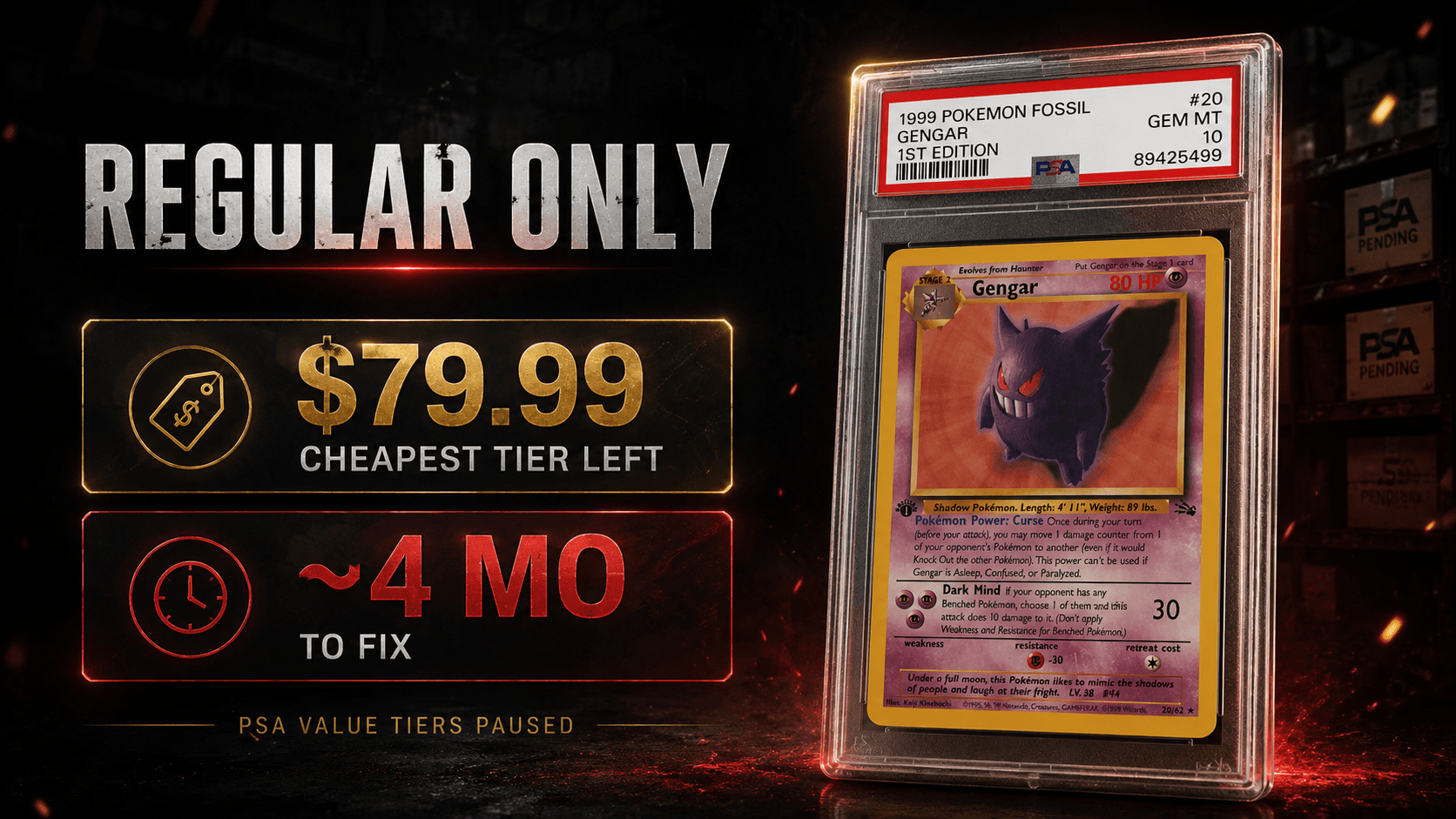
And it isn't only PSA. TAG suspended several of its own service levels the same week, citing demand, with no reopening date attached.
For anyone grading in volume, the affordable option just disappeared until the fall. That changes how people grade for the rest of the year.
Why it stings more this time
The pause landed on a hobby that was already frustrated, and the reasons go past turnaround times.
Start with consolidation. PSA's parent, Collectors Holdings, now also owns SGC (since February 2024) and Beckett, or BGS (since December 2025). Three of the four largest graders share one owner. CGC is the lone major independent left standing.
An April 2026 class action lawsuit, Rasmussen v. Collectors Holdings, alleges that combination puts roughly 80% of the grading market under one roof, and that earlier acquisitions were followed by higher prices and slower turnarounds. Those are allegations so far, not yet proven in court, and the company disputes the framing.
Then there's trust. In December, a collector sent PSA roughly 30 copies of the same modern card and got mostly 9s back. They then sold several of those 9s to PSA itself, through its buyback program, at the going rate for a 9. Soon after, 11 of those exact cards, same certification numbers, were regraded as 10s, which sell for several times more. So PSA graded the cards low, bought them at the low price, then marked its own cards up. PSA says a senior reviewer simply re-checked them after the collector complained publicly, and denies any intent to deceive. The regrade is confirmed. The motive is what's in dispute. Either way, it became the clearest example yet of a complaint collectors have had for a while: the company that grades your card shouldn't also be the one buying it.
All of this is hitting at once. The biggest grader is turning away cheap submissions, it owns most of the competition, and it's defending its reputation in public. Collectors have plenty of reasons to look elsewhere, and some are.
High confidence the frustration is real and broad. The legal and fraud claims are unproven, and we're treating them as claims.
The independents get a look
CGC is the obvious first call as the established independent, and it's already seeing the volume. But the more interesting story is the newer names entering the conversation. Independent competition is good for collectors, and right now there are real reasons to root for it.
The one getting the most attention is Premier Card Grading. Standard grading runs about $19.95 a card with subgrades and a metal label included, an express lane is quoted at 7 to 10 business days, and it grades across Pokemon, Magic, One Piece, Lorcana, and more. Set that against a $79.99 PSA floor backed up for months, and the value case is easy to see.
The honest caveat is resale liquidity. A slab is only worth what the next buyer trusts, and newer labels still trade at a discount while buyers anchor to the big three names.
But that gap is closeable, and this is exactly the kind of moment that closes it. If collectors use Premier through a four-month PSA pause and come out with clean experiences, that reputation compounds. The liquidity follows the trust. With what's coming in the fall, there are going to be a lot of first-time subs heading somewhere. Some of them may not go back.
The market is in the waiting room
Step away from all that and the market itself is doing one thing. It's waiting.
The two catalysts everyone is pointed at are still a full quarter out. The 30th Celebration set had its first reveal on June 1, with a worldwide release set for September 16, the first simultaneous global Pokemon TCG launch. More cards are still to be revealed.
The other one is Mega Rayquaza ex, the headliner of Storm Emerald, which lands in Japan on July 31 with an English release expected around September.
With the big releases months away, modern sealed is doing exactly what we flagged last week: stabilizing. Coming off a long run, ETBs, bundles, and boxes are consolidating rather than breaking. After a stretch like that, some flattening is normal.
Vintage keeps printing the occasional record on genuine scarcity, the low-pop slabs and trophy pieces that don't come up often. We're still seeing monster sales clear at the top end. But the broader vintage read is mostly chop right now.
The read
Grading is the bigger story. The default grader hit the ceiling on both capacity and collector trust at the same time, and people are shopping around for the first time in a while. The real question is whether they go back to PSA when it reopens, or whether four months of alternatives actually shifts habits.
The cards are calmer than the grading story suggests. Prices have stalled more than fallen, and a slow June right before a worldwide 30th set and the Mega Rayquaza chase looks like timing, not weak demand. The back half of the year has a lot of reasons to be active.
The Daily Chase
Get the next one in your inbox.
Daily TCG market intelligence. Read in five minutes. Free.
Keep reading